














On the bustling set of Genoa City, a recent episode of The Young and the Restless delivered a seismic confrontation that has left viewers reeling and social media ablaze. The usually volatile Adam Newman, often cast as the antagonist, stepped into an unfamiliar role: that of a truth-teller. His target? The seemingly sophisticated billionaire, Cane Ashby, whose burgeoning empire, Arabesque, now faces searing accusations of corporate malfeasance and technological theft. What makes this showdown particularly compelling is not just the audacity of Adam’s claims, but the undeniable, on-screen evidence supporting every single one. For those who witnessed the intense exchange at Society on November 13th, the truth was laid bare: Adam Newman’s indictment of Cane Ashby was not merely spiteful rhetoric, but a precise, fact-backed exposé.
Adam Newman’s Bold Confrontation: Every Accusation Rooted in Fact
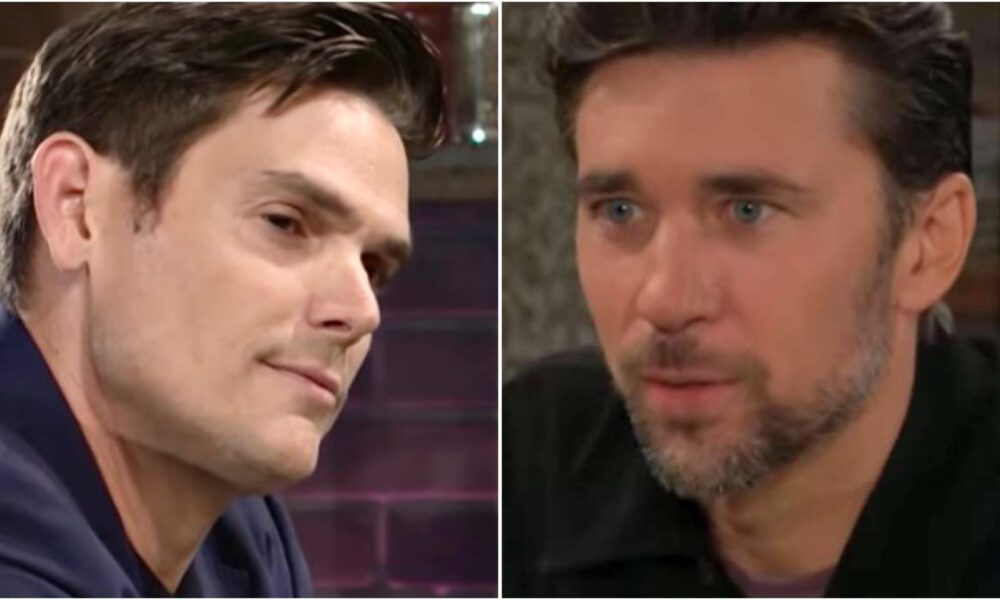
The tension was palpable as Adam Newman (played by Mark Grossman) cornered Cane Ashby (Billy Flynn) at Society, unleashing a barrage of accusations. While many fans might instinctively dismiss Adam’s words as typical Newman drama, the reality is far more intricate. Adam wasn’t merely attempting to sow discord; he was meticulously echoing a profound investigative piece published by Newman Media just weeks prior, in October. This comprehensive report left no stone unturned, detailing the illicit foundations upon which Cane Ashby’s company, Arabesque, was built.
The core of Adam’s allegations revolved around two critical points: the dubious origins of Arabesque’s funding and the unethical acquisition of its core technology. Newman Media’s exposé, which notably received the tacit approval of the formidable Victor Newman (Eric Braeden) himself, definitively proved that Arabesque was financed by the ill-gotten gains of Cane’s notorious con-artist father, Colin Atkinson. Atkinson’s “last scam in Nice,” involving the swindling of a wealthy elderly woman, provided the initial capital for Cane’s supposed legitimate enterprise. Furthermore, the report confirmed that the advanced AI technology at the heart of Arabesque was not developed legitimately, but brazenly stolen.
Beyond the financial and technological crimes, Adam’s confrontation also brought to light Cane’s true, sinister agenda for Genoa City. Far from being a benevolent entrepreneur, Cane harbored a deeply personal vendetta, aiming to “take everything” from the city’s most prominent legacy families: the Newmans, the Abbotts, and even the Winters. This wasn’t mere corporate competition; it was a declared war, meticulously planned and executed. The “Aristotle Dumas” persona, Cane’s enigmatic billionaire identity unveiled earlier in France, was revealed to be nothing more than a carefully constructed facade, a rebrand designed to mask his criminal origins and destructive intentions. This confrontation was more than just a heated argument; it was a public declaration of war, backed by an overwhelming amount of evidence.
The Deceptive Foundations of Arabesque and the Aristotle Dumas Persona
Delving deeper into the facts, Cane’s entire operation, Arabesque, stands on shaky, unethical ground. The funding from Colin Atkinson’s nefarious scheme in Nice is a crucial detail, painting Cane not as a self-made man but as a beneficiary of his father’s crimes. This isn’t a small loan; it’s the very seed money that allowed Arabesque to flourish. Coupled with the outright theft of advanced AI software, the picture becomes clear: Cane Ashby’s vision for Arabesque is built on a foundation of deceit and illegality. The sophisticated algorithms and powerful data analysis tools he wields were not innovated but appropriated, giving him an unfair and unlawful advantage in the cutthroat world of corporate espionage. The persona of “Aristotle Dumas,” which Cane introduced with such theatrical flair, served as a smokescreen, intended to distance him from his true, criminal roots and to present an image of legitimate power and success. This elaborate charade was designed to deceive not only the business world but also those closest to him, including Lily Winters.
Cane’s “Gatsby” Vision: A Facade for Corporate Terrorism
Actor Billy Flynn, who portrays Cane Ashby, once described his character’s motivations in interviews, drawing a parallel to F. Scott Fitzgerald’s classic novel, The Great Gatsby. He suggested that Cane “created Aristotle Dumas the way that James Gatz created Gatsby,” with Lily Winters as his “Daisy,” all in an effort to prove his worth and win her back. On the surface, this narrative might sound tragically romantic—a man building an empire for the sake of his one true love. However, the on-screen reality of The Young and the Restless paints a starkly different, far more sinister picture.
Cane’s actions hardly align with the endearing gestures of a man trying to reconcile with his former spouse. He isn’t sending flowers or penning heartfelt letters. Instead, he is actively deploying “destructive AI” to launch a “strategic assault” against businesses connected to Lily, particularly Chancellor-Winters, where she holds a significant position. His targets aren’t just impersonal corporate entities; they are the very fabric of Lily’s life, encompassing her relatives, her friends, and her entire professional world. How can systematically dismantling her family’s businesses and targeting her loved ones be construed as a romantic gesture? It cannot. This isn’t a modern-day Gatsby; it is an act of calculated corporate terrorism, meticulously disguised within a veneer of sophisticated ambition. Adam Newman, the perennial villain of Genoa City, is paradoxically the one with the courage and clarity to call out this dangerous charade for what it truly is. The contrast between the stated romantic motivation and the brutal corporate strategy could not be more stark.
The Strategic Assault on Genoa City’s Pillar Families
Cane Ashby’s plan extends far beyond winning back Lily; it is a full-scale assault on the very foundations of Genoa City’s economic and social landscape. By specifically targeting the Newman, Abbott, and Winters families, Cane aims to dismantle the power structures that have long defined the city. This isn’t about competition or innovation; it’s about revenge, pure and simple. His use of stolen AI technology for “strategic assault” highlights the insidious nature of his ambition. It’s a ruthless tactic designed to cripple and ultimately destroy, leaving a trail of devastation that impacts countless lives beyond his primary targets. Lily Winters, unknowingly caught in the crosshairs of Cane’s elaborate revenge scheme, stands to lose not just a potential relationship, but her professional standing and the security of her family’s legacy.
Adam Newman’s Unforeseen Evolution: An Unexpected Hero?
It’s a statement that would have been unthinkable just a short while ago: Adam Newman as a hero. Yet, in this unfolding saga, it’s a narrative gaining undeniable traction. Adam’s history is a litany of transgressions: he stole baby Faith, was involved in the tragic hit-and-run that killed Delia Abbott, and gaslit Ashley Abbott. His past is undeniably dark, a complex tapestry of morally ambiguous acts. However, a significant shift has occurred in his character arc. For the first time in his tumultuous life, Adam finds himself “safely tucked into the Newman family fold.” He’s no longer the notorious black sheep, forever seeking to undermine his father and siblings. Instead, he has embraced a role as Victor’s enforcer, a loyal son dedicated to protecting the family’s extensive business interests from external threats.
What makes this transformation even more compelling are the subtle nuances of Adam’s behavior following his confrontation with Cane. Spoilers reveal that Adam is far from gleeful about Cane’s impending downfall; he reportedly “looks upset” and lacks his usual predatory enthusiasm. Even Chelsea Lawson (Melissa Claire Egan), ever observant of Adam’s psyche, is confused by his subdued reaction. This isn’t the old Adam—the chaotic agent who reveled in destruction. This is a new, conflicted Adam, performing a necessary cruelty out of loyalty to Victor, but privately grappling with the profound human cost of his actions. This demonstrates remarkable character growth, hinting at a deeper moral compass finally surfacing within him. He is navigating a complex ethical landscape, proving that even the most notorious villains can evolve.
From Chaos Agent to Conflicted Protector: Adam’s Shifting Allegiances
The transformation of Adam Newman from a relentless chaos agent to a conflicted protector represents one of the most intriguing developments in The Young and the Restless. His current position within the Newman family, solidified through his loyalty and effectiveness, provides him with a stability he has rarely known. This newfound stability, however, comes with its own set of moral dilemmas. While he executes Victor’s directives with ruthless efficiency, the emotional toll is evident. The internal struggle between his past inclinations for destruction and his burgeoning sense of responsibility for the family’s well-being is a powerful driving force in his current storyline. This internal battle suggests that Adam is perhaps seeking redemption, not through overt acts of heroism, but through a quiet, personal reckoning with the consequences of his actions, both past and present.
Unpacking Fan Reaction: The Real Reason Behind Cane Ashby’s “Defense”
Given the irrefutable evidence against Cane Ashby—his stolen funds, his pilfered technology, his vengeful corporate assault—one might expect an overwhelming consensus among fans condemning his actions. Yet, online forums and social media platforms reveal a curious phenomenon: a significant number of viewers appear to be “defending” Cane. However, a deeper look uncovers a heartbreaking truth that has little to do with Cane Ashby’s character and everything to do with the actor portraying him.
The true source of fan sympathy for Cane lies in the controversy surrounding the recast of the character. Billy Flynn stepped into the role of Cane Ashby in June 2025, replacing the beloved fan-favorite Daniel Goddard. This change sparked a brutal backlash across social media. Fans have vehemently expressed their disappointment, labeling the recast as “horrible” and asserting that Flynn is “miscast.” The absence of Cane’s iconic Australian accent, a hallmark of Goddard’s portrayal, has particularly incensed long-time viewers. Even Christel Khalil, who plays Lily Winters and shares significant screen time with Cane, has publicly appealed to fans to “give Flynn a chance” and to “look at it like a new relationship.” This plea underscores the depth of fan attachment to Goddard’s portrayal and their resistance to accepting a new actor in such an iconic role.
Therefore, when “sympathy” for Cane Ashby surfaces online, it’s crucial to understand its true nature. It is not an endorsement of his villainous scheme to dismantle Genoa City’s core families using illicit AI technology. Such a defense would indeed be illogical and perhaps even perverse. Instead, it is a heartfelt, albeit misguided, expression of loyalty to Daniel Goddard and a collective frustration over the show’s decision to recast a character deeply embedded in the hearts of its audience. Fans are not defending the villain; they are mourning the loss of a familiar face and voice.
The Recast Conundrum: When Character and Actor Merge in Fan Perception
The fervent reaction to Cane Ashby’s recast highlights a perennial challenge in the world of long-running soap operas: the powerful bond between an actor and the character they portray. For many viewers, Daniel Goddard was Cane Ashby, and his distinct accent and mannerisms became inseparable from the character’s identity. The introduction of a new actor, regardless of their talent, inevitably creates a disconnect for an audience deeply invested in years of continuity. This phenomenon underscores how fan loyalty often transcends plotlines and character actions, becoming deeply intertwined with the performer. The “defense” of Cane, therefore, serves as a poignant reminder of the emotional investment viewers place in these fictional worlds and the individuals who bring them to life.
The Future Unfolds: What Lies Ahead for Genoa City’s Key Players
As the dust settles from Adam Newman’s explosive revelations, the stage is set for an intricate web of developments in Genoa City. Victor and Adam, now united in their corporate assault, are pushing forward with their plans against Cane Ashby and Billy Abbott’s (Jason Thompson) new venture. However, Cane’s “strangely zen” demeanor in the face of Adam’s accusations hints at a deeper game. Such an unperturbed reaction suggests he likely has a formidable backup plan already in motion, implying an escalation of his revenge plot that could have catastrophic consequences for the city’s power players. His calmness should, in fact, be a cause for terror, as it suggests a calculated move rather than a desperate one.
Meanwhile, Adam’s internal conflict over his role in Cane’s downfall foreshadows a pivotal moment. The skilled writers of The Young and the Restless appear to be building towards a crucial dilemma for Adam: a forced choice between his burgeoning conscience and his unwavering loyalty to his father, Victor. This choice could very well define his future, determining whether he remains a “full family member” within the Newman fold or reverts to his infamous status as the family’s black sheep. His journey of self-discovery, prompted by this moral quandary, promises to be one of the most compelling aspects of the upcoming episodes.
And then there’s Lily Winters. Her path is set to collide dramatically with Cane’s manipulations, as spoilers indicate she is about to discover Phyllis Summers (Michelle Stafford) and Cane in a “compromising position.” This inevitable revelation will likely serve as the catalyst for Lily to finally strip away the romanticized image of Cane she once held and confront the villain he has truly become. Her heartbreak and subsequent realization will undoubtedly add another layer of emotional complexity to an already volatile storyline. The intricate dance of ambition, betrayal, and evolving character arcs ensures that Genoa City will remain anything but quiet.